Maxim Papric
7/3/2023
-
9 min. reading time


Here is the complete post body without an H1—this means the CMS “Name” field remains the only H1 on the page.
A food truck —also spelled “Food-Truck” or, in the English spelling, “Food Truck”—is a mobile retail vehicle from which food and, often, beverages are sold or served. Depending on the concept, the food is prepared, fully cooked, or simply plated inside the vehicle. Many food trucks have a built-in kitchen for this purpose. They can travel to different locations, be used for public sales, or be booked as food truck catering for events.
In a nutshell:
The Duden recommends the spelling “Foodtruck” and accepts “Food-Truck” as an alternative. “Imbisswagen” is used as a synonym. The term “Speisewagen,” on the other hand, is not appropriate: in German, it refers to the dining car on a long-distance train.
Mobile kitchens predate the automobile. An important technical precursor was the chuckwagon: In 1866, Texas cattle rancher Charles Goodnight had a former army wagon converted into a mobile kitchen for long cattle drives. The wagon transported food, cooking utensils, and water, and provided for the crew along the way. It was not yet a public food truck, but it demonstrated the early concept of a kitchen on wheels.
At the same time, in the late 19th century, horse-drawn wagons and handcarts began appearing in American cities, supplying workers with coffee, sandwiches, and hot meals. Beginning in 1872, Walter Scott sold food to shift workers in Providence from a converted wagon. Such “lunch wagons” are considered early commercial precursors to today’s food trucks.
In the 20th century, ice cream trucks, mobile cafeterias, and snack trucks followed. Modern food truck culture gained new momentum starting in 2008: concepts like Kogi Korean BBQ in Los Angeles combined a specialized cuisine with real-time location updates via social media. In Germany, the modern food truck concept has become particularly widespread since the early 2010s.
Today, food trucks are no longer just a part of street vending. They are used as mobile kitchens for corporate events, weddings, trade shows, festivals, roadshows, and temporary employee catering.
A food truck is more than just a vehicle with a service hatch. Professional models combine several culinary functions in a small space:
How much is actually prepared in the truck depends on the concept. Often, individual components are prepared in a prep kitchen and then freshly fried, grilled, plated, or finished on site. This keeps the distance short and allows guests to experience the cooking process firsthand.
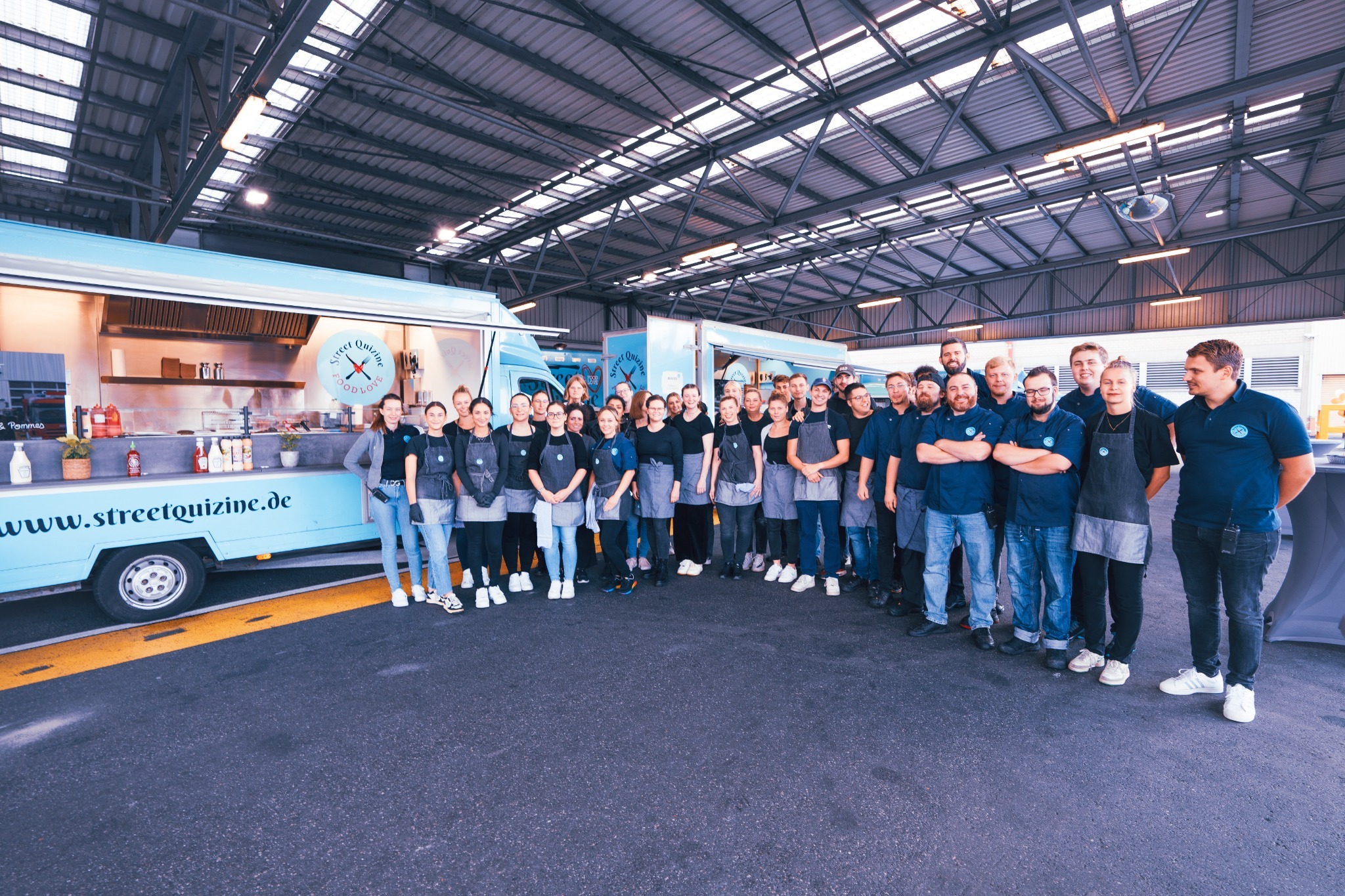
At StreetQuizine, the focus isn’t just on the vehicle, but on the entire event experience. According to information on its website, as of September 2026, the team—which was founded in 2017—has supported more than 2,500 events with over 250,000 guests. The food trucks are operated by trained chefs; the food, service, logistics, and—upon request—branding are all tailored to the event.
Our most important lesson: The number of food trucks alone doesn’t determine the success of an event. What really matters is the complexity of the menu, serving capacity, the number of service stations, time slots, and guest flow. According to our own data, at large events, a well-coordinated multi-truck or multi-station concept can serve up to 1,500 guests per hour—depending on the menu and on-site conditions. You can find more information in the guide to food truck catering for large events.
Food trucks can offer almost any type of cuisine: burgers and barbecue, bowls, sandwiches, pasta, international specialties, desserts, or drinks. Many concepts deliberately focus on just a few dishes. A compact menu simplifies preparation, makes service more predictable, and can still offer options to suit different dietary needs.
Vegetarian and vegan dishes, clearly labeled allergens, and gluten- or lactose-free options play an important role when catering to mixed groups of guests. Not every food truck can reliably accommodate every dietary restriction; therefore, event organizers should discuss specific requirements early on and in detail.
At StreetQuizine, for example, you can combine burger, BBQ, and bowl concepts, as well as vegetarian and vegan options. The dishes and menu packages provide an overview.
A food truck doesn’t automatically mean gourmet cuisine—quality comes from good ingredients, a well-chosen menu, clean processes, and skilled preparation. The limited space, in particular, calls for a well-planned mise en place: every step of the process must be executed perfectly so that dishes can be served fresh and with consistent quality.
This format offers unique opportunities. Chefs work in full view of the guests, dishes are served immediately after preparation, and the menu can be tailored to the occasion, season, or brand. In this way, a mobile kitchen can become a live cooking experience without replicating the workflow of a traditional restaurant.
At StreetQuizine, trained chefs handle the food preparation in the food trucks. For event organizers, in addition to taste, it is especially important that quality and serving speed are planned together.
Food trucks have established themselves as part of the mobile food service industry. Rather than making blanket growth forecasts, four specific trends can be observed as of September 2026:
The key to long-term success remains the same: a food truck succeeds when food quality, hygiene, service, and logistics work together seamlessly.
A food truck is a mobile sales vehicle used to sell or serve food and, often, beverages. Depending on the concept, the food may be prepared, fully cooked, or simply plated inside the vehicle. The truck can be used for public sales or as a booked event catering service.
There is no legally standardized definition of quality. In common parlance, “food truck” often refers to a mobile, specialized, and strongly branded food service concept; “snack truck” is the more general term and can also refer to a permanently stationed food truck.
No. "Street food" refers to the food itself or the way it is sold, while "food truck" describes the vehicle. Street food can also be sold from a stand, a trailer, or a cargo bike.
That depends on the vehicle and the menu. Typically, a sufficiently wide, level, and sturdy access road and parking area are required, as well as appropriate solutions for electricity, water, wastewater, and waste disposal. According to current information on their own website, StreetQuizine usually only requires a standard household 230-volt outlet with appropriate safety features; the team brings its own water if needed. High-power equipment or larger setups must be coordinated in advance.
Food trucks are ideal for corporate parties, weddings, trade shows, roadshows, customer events, birthdays, festivals, and as temporary employee catering, among other occasions. It is crucial that the menu, capacity, and setup align with the schedule and the number of guests.
It would be unreliable to give a flat figure. The capacity depends on the menu, the level of preparation, the team, the number of serving stations, and the available time slot. For large events, StreetQuizine plans to use multiple trucks and stations as needed and, according to its own figures, can accommodate up to 1,500 guests per hour with appropriately designed overall concepts.
The price depends primarily on the number of guests, the menu selection, the duration of the event, travel distance, staff, and additional services. Rather than a seemingly fixed average price, it makes sense to provide a quote based on the same service components. Current examples can be found in the cost guide for food truck catering.
No. On private property, the owner’s consent is required. On public streets, a special use permit is generally required; for events, the use may already be regulated by the event organizer. In addition, depending on the business model, there may be requirements under commercial, food safety, and hygiene laws. Responsibilities vary by municipality, state, location, and type of business; if in doubt, you should contact the relevant local authority.
A food truck is a mobile kitchen that serves food directly to customers—and, depending on the concept, it can also function as a restaurant, a catering station, and an experiential space. Its strength lies in the combination of mobility, a focused menu, visible food preparation, and personal interaction.
When it comes to events, it’s not just about which food truck shows up—it’s also about how the menu, capacity, service, and location are planned. StreetQuizine combines these elements into a catering concept that can be used throughout Germany for corporate and private events. If you’d like to know what’s right for your occasion, you can request a no-obligation quote for your event.
About the Author: Maxim Papric is the founder of StreetQuizine GmbH. Since 2017, the team has been developing and providing food truck catering services for corporate and private events. According to information on its website as of September 2026, StreetQuizine has organized more than 2,500 events with over 250,000 guests.
Editorial Status: Content and technical information updated on September 18, 2026. This article combines the practical experience of the StreetQuizine team with the expert and primary sources listed below. Legal notices are provided for general guidance only and do not replace individual advice.
Sources for this article: