Maxim Papric
February 9, 2026
-
6 min. reading time

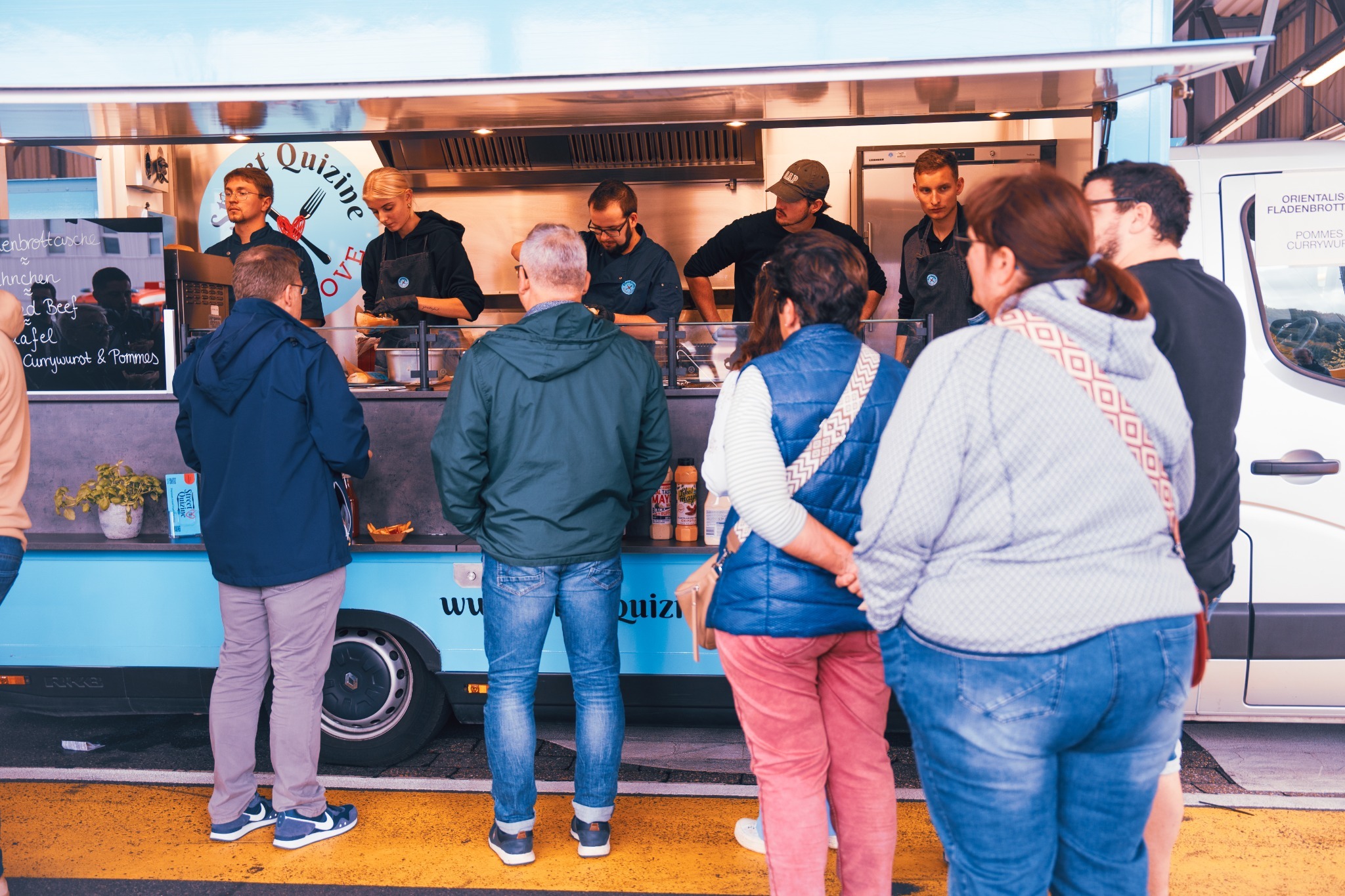
Short answer: StreetQuizine can provide full food truck catering for corporate events with 500, 1,000, or several thousand guests. We have seven of our own food trucks as well as additional mobile food and beverage stations available for this purpose. When serving food simultaneously, we generally plan for approximately one food truck or one serving station per 250 guests. Thanks to menu concepts specifically tailored to large-scale events, we can sometimes achieve significantly higher service speeds.
The actual number of food trucks needed depends not only on the number of guests. Other key factors include the menu, the event venue, the desired selection, and whether all guests will eat at the same time or spread out over several hours.
For a standard catering event with multiple food options, a StreetQuizine food truck can serve up to 250 portions per hour, depending on the menu. With seven food trucks operating simultaneously, we can serve a total of more than 1,500 guests per hour.
For very large corporate events, we often develop a particularly fast service concept. Each food truck then offers only one main dish—such as burgers, bowls, BBQ, or pita. This allows the food to be prepared in advance to a greater extent and served much more quickly.
Depending on the venue, this single-venue concept can accommodate more than 300 guests per hour and truck in some cases, and even more than 400 guests per hour and truck at venues where service is particularly fast. However, we do not apply these peak figures across the board to every event. Binding capacity planning is determined on a case-by-case basis based on the selected menu and the event schedule.
If all guests are expected to eat at roughly the same time, we plan on a rough guideline of about one food truck or food station for every 250 people. Our goal is to serve every guest at least once within about 30 to 45 minutes, even with several thousand guests.
If, on the other hand, visitors arrive spread out over several hours, a smaller number of food trucks may be sufficient. A family day, where guests arrive between 11 a.m. and 5 p.m., requires a different approach than a company meeting, where all employees want to eat at the same time immediately after a speech.
The number of food trucks should therefore never be determined solely based on the total number of invited guests. In particular, we take the following into account:
In addition to our seven food trucks, we can set up additional mobile food stations. This allows us to increase our overall capacity without needing another truck for every additional dish.
The most important factor is realistic planning for the expected crowd. For an event with a large number of staff, we recommend—whenever possible—not waiting until after a group speech or a specific program item to begin serving food. If food service begins earlier, guests will automatically spread out more evenly across the available stations.
If everyone is supposed to eat at the same time, we’ll increase the number of food trucks and serving stations accordingly. At large events, each truck intentionally offers only one dish. This allows guests to quickly see which truck serves burgers, bowls, BBQ, pita, or other dishes.
Other measures to combat long lines include:
If we also handle the event management, we can additionally create signage and a site map. This way, visitors will know right away what food is available at each food truck and station.
StreetQuizine regularly organizes corporate events with several hundred or several thousand guests. Three examples illustrate how varied the appropriate planning can be.
At a major trade show organized by BÄKO West eG, approximately 1,000 guests were scheduled to eat within a specific time frame. To accommodate this, four food trucks serving meals that could be served particularly quickly were deployed.
In addition, we set up a large beverage bar and placed our blue self-service carts filled with chilled soft drinks throughout the venue. Finger foods and desserts were set out at stations that were freely accessible to guests.
Although most of the guests wanted to eat at the same time, the maximum wait time was about 15 minutes.
At a large summer festival hosted by Marienhaus in Waldbreitbach, the approximately 3,000 visitors arrived throughout the day. Four food trucks were used to serve the main courses: two burger trucks and two bowl trucks.
In addition, we set up four separate crêpe stations. Thanks to the even distribution of guests and the clear organization of the dishes, there were no significant lines. Serving at each station typically took about one minute.
StreetQuizine catered to approximately 6,500 guests at a family day event hosted by the manufacturing company Speira in the Neuss-Grevenbroich region. Visitors arrived between 11 a.m. and 5 p.m., spreading out over the course of the event.
Seven food trucks offering a variety of culinary concepts were in operation. Despite the high total number of visitors, there were no significant lines. At each truck, guests typically received their food within about a minute.
These examples illustrate why the total number of guests alone says little about the actual number of food trucks needed. The distribution of guests over time is at least as important.
Yes. StreetQuizine can accommodate different groups of employees at various times and, with proper planning, even over a 24-hour period. We have already implemented such shift schedules for large companies.
It is also possible to have multiple company locations or events taking place simultaneously. For roadshows, a consistent catering and setup concept can be developed and then implemented at different locations.
Thanks to our locations in Korschenbroich and Augsburg, we can organize corporate events in western and southern Germany, and—depending on the size of the event—throughout Germany.
Each food truck should be provided with a level and safely accessible parking space measuring approximately 7 by 3.5 meters. For vehicle access, we generally require a minimum width of 3.30 meters and a minimum clearance height of 3.20 meters.
For each food truck, we typically need a standard 230-volt household electrical outlet. A wastewater connection is not required. A water connection is generally not needed either, but it can be helpful for large-scale events.
Before the event, we work with the company or the event agency in charge to check the access routes, parking areas, power supply, and the planned layout of the distribution points.
Yes. In addition to food truck catering, StreetQuizine can handle the complete planning and execution of the food service areas or, upon request, the entire event planning process.
These include, for example:
We have many components in our own inventory. We arrange additional special equipment or program items through our network of experienced partners. The company is assigned a dedicated point of contact who coordinates the various departments involved.
For soft drinks, we like to use our blue self-service wheelbarrows at large venues. These are stocked with chilled soft drinks, ice, and—upon request—beer, and are restocked regularly throughout the event. We serve wine, long drinks, Aperol, Lillet, and other beverages at staffed bars.
For large-scale events, we prepare a customized schedule and contingency plan in advance. Depending on the size of the event, we have alternative vehicles, additional food stations, or other options for relocating the service area ready.
The food concepts are planned in such a way that, in the event of a last-minute change, capacity can be redistributed among several food trucks or stations. In addition, there is a central project management team that coordinates all food service areas on the day of the event and can respond immediately to any deviations.
The specific reserves to be set aside depend on the number of guests, the location, and the scope of the event. This contingency plan is established as part of the project planning process.
For large events, we recommend submitting a request at least six months before the desired date. This allows sufficient time for planning the venue, staffing, catering, and logistics.
However, it is still possible to organize the event on shorter notice, provided that there are still enough food trucks, staff, and equipment available on the day of the event. Dates that are particularly in demand during peak season may already be booked well in advance.
The price of the meal depends mainly on the number of guests, the chosen dish, and the desired variety. For large corporate events, a simple concept featuring a single dish—such as a menu consisting exclusively of burger trucks—starts at approximately 19 euros net per person.
If you'd like a variety of meal options and a wider selection, the main courses will cost up to approximately 27 euros (net) per person, depending on the menu.
In addition, the following items may be included:
Since a corporate event where the meal begins at a specific time differs significantly from a family day that spans more than six hours, we develop a customized capacity and cost plan for each large-scale event.
To provide an initial estimate, we need the event date, the event location, the expected number of guests, the desired time slot, and a brief description of the planned event schedule.
Based on this, we’ll develop a customized plan that includes food trucks, additional stations, beverages, and optional full-service offerings. You’ll typically receive an initial response or a customized quote within 24 hours on weekdays.
Plan a Large-Scale Event with StreetQuizine
As of September 2, 2026. Capacities and serving speeds are based on experience and planning estimates. The actual number of food trucks and stations required depends primarily on the menu, the event venue, the serving time, and the distribution of guests over time. All prices listed for corporate customers are net and exclude applicable sales tax.


